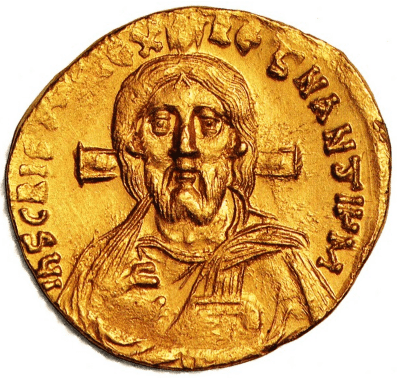
 Stephen Jones continues his four proofs:
The faces of Jesus on these coins are of two types: an earlier "Syrian Christ" and a later more Shroud-like Jesus. [ibid] Features on the coins which are very similar to the face of the Man of the Shroud include: long wavy shoulder-length hair, a long forked beard, moustache, and a small tuft of hair on the forehead, and no ears visible. [2] As can be seen above, there are at least twelve out of fifteen Vignon markings on the Christ face of this coin that are also found on the Shroud of Turin: "… (2) three-sided `square’ between brows, (3) V shape at bridge of nose, … (6) accentuated left cheek, (7) accentuated right cheek, (8) enlarged left nostril, (9) accentuated line between nose and upper lip, (10) heavy line under lower lip, (11) hairless area between lower lip and beard, (12) forked beard, (13) transverse line across throat, (14) heavily accentuated owlish eyes, (15) two strands of hair." [3] See part #2 (1) .
. . .
Since these coins are datable to about AD 692, and the Shroud is the original because what are physical flaws in its cloth have been meaninglessly represented [7] – see part #2 (1) – in Byzantine art works between the sixth and twelfth centuries, this means that the Shroud must have been in existence at least five centuries before the earliest AD 1260 date ascribed to it by the 1988 radiocarbon dating. [8] Therefore that "medieval … AD 1260-1390" radiocarbon date of the Shroud [9] simply has to be wrong!
This is great stuff.
It comes to mind that we need a single sheet pictorial inventory of the most significant Byzantine coins so we can stare at them all together.