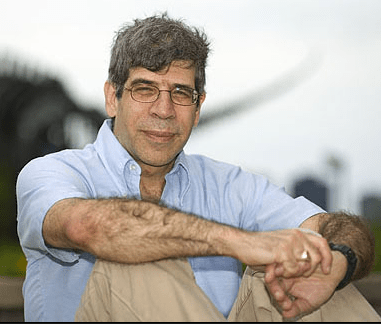
 The University of Chicago’s Jerry Coyne (pictured) is enjoying himself over at his blog, Why Evolution Is True. He tells us that Stenger spices up HuffPo again :
Today’s HuffPo features a column by Victor Stenger—”Scientists and religion“—that’s reprinted from “Science + religion today.” His point is to dispel the old canard that science can’t test God or the supernatural. (I once had a long argument with Genie Scott of the National Center for Science Education about this—she took the “can’t-test” side). And the reasons he’s right are bloody obvious, but can’t be said too often, especially since the “can’t-test” position appears in official statements by America’s two most prestigious science organizations: the AAAS and the National Academies:
The rationale usually given by those who reject any role for science on religious matters is that science concerns itself, “by definition,” solely with natural phenomena. Since the supernatural is unobservable, then, they assert, science has nothing to say about it.
However, while supernatural entities may not be directly observable, any effects these entities might have on the material world should manifest themselves as observable phenomena. Anything observable is subject to scientific inquiry. On the other hand, if the supernatural has no observable effects on the natural world, then why even worry about it?
[Some discussion about prayer and NDEs]
Now it’s harder to test one-off interventions like the supposed resurrection of Jesus, but everything we know about nature suggests that dead people can’t come back to life, and there’s no independent evidence for this outside the Gospels. And if you show that the more frequent interventions of God are bogus, one naturally begins to suspect the one-off miracles as well. Even when one-off miracles are tested, like weeping Jesus statues or the Shroud of Turin, they, too, fail to pass the test of divinity.
I wasn’t able to make any headway with Genie, who was either deaf to my assertions or determined to defend a position that the NCSE has adopted to coddle believers; and I suspect Stenger won’t make headway with most HuffPo readers (watch the comments section). Nevertheless, he’s right. As I pointed out today, Gould’s “nonoverlapping magisteria” brand of accommodationism works only with deistic religions that posit a hands-off God. And, in the West, that kind of religion is found only among well-fed theologians and extremely liberal believers.
Victor’s penultimate paragraph:
So, scientists and science organizations are being disingenuous when they say science can say nothing about the supernatural. They know better. Their policy of appeasing religion for presumably political reasons only empowers those who are muddling education and polluting public policy with anti-scientific magical thinking.
Can anybody really deny that? They do know better, or if they don’t, they’re dumb.
I hope they don’t bounce Stenger’s tuchus from HuffPo, since he violates Arianna’s mission of reconciling science and faith. But perhaps he gives them what they want most: traffic. And traffic = $$ (for HuffPo, not Stenger: columnists aren’t paid there).
Notice how much the Shroud of Turin is popping up in so many stories and articles lately.