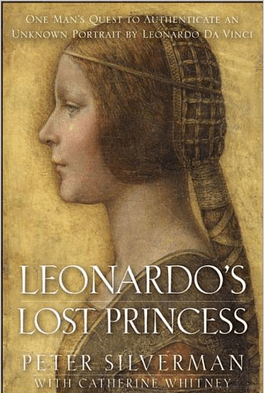
 An interesting reference to the Shroud of Turin carbon dating in Leonardo’s Lost Princess: One Man’s Quest to Authenticate an Unknown Portrait by Leonardo Da Vinci by Peter Silverman, Catherine Whitney (John Wiley & Sons, Jan 25, 2012 – 288 pages).
The most famous and controversial case of carbon-14 testing involved the Shroud of Turin, the cloth that is alleged to have been the burial shroud of Jesus. In 1988, carbon testing revealed that the age of the cloth was medieval, which means it could not have belonged to Jesus. That might have settled the matter once and for all, but there was so much interest in the Shroud of Turin, and so much passion among true believers about proving its authenticity, that speculation raged about possible explanations for the “false” result.
In 2005, Raymond N. Rogers. a highly respected chemist and a fellow of the Los Alamos National Laboratory, revealed in a scientific journal that the entire cloth was much older than the test sample—at least twice as old, and possibly two thousand years old. The explanation: the corner that was tested had been subject to mending and thus contained newer material. Rogers’s discovery did not stop the controversy, and studies of the Shroud of’ Turin continue.
I think we are seeing more and more references to Rogers in popular media and mainstream books.
From the publisher:
How an oddly attributed $19,000 picture proved to be a $100 million work by Leonardo da Vinci–a true art-world detective story.
In late 2010, art collector Peter Silverman revealed that a "German, early 19th century" portrait he had bought for $19,000 was, in fact, a previously unknown drawing by Leonardo da Vinci–an exquisite depiction of Bianca Sforza, rendered 500 years ago. In "Leonardo’s Lost Princess," Silverman gives a riveting first-person account of how his initial suspicions of the portrait’s provenance were confirmed repeatedly by scientists and art experts. He describes the path to authentication, fraught with opposition and controversy. The twists and turns of this fascinating, decade-long quest lead from art history to cutting-edge science, and from a New York art gallery to Paris, Milan, Zurich, and ultimately a Warsaw library where the final, convincing evidence that the portrait was indeed by da Vinci was found.Takes an up-close look at the workings of the art world and at figures ranging from dealers and connoisseurs to a suspected forger Discusses current scientific techniques used to investigate and authenticate works of art, such as carbon dating and cutting-edge photography Uses Silverman’s drawing as an entree into Leonardo da Vinci’s world: his studio, his style, and his methods Explores the intersection of art and science in the authentication process, involving the work of a man who embodied that intersection
Unearthing the secrets almost lost to history, the book is ideal reading for art lovers and anyone interested in an astounding case of "whodunit."