Coming to a bookstore near you on September 18. I can hardly not wait:
LOS ANGELES, CA–(Marketwire – Jul 10, 2012) – When it comes to writing groundbreaking historical fiction, Robin Maxwell (www.robinmaxwell.com) isn’t one to monkey around. Acclaimed for her “electrifying prose,” (Publishers Weekly), the bestselling author relishes exposing the shocking secrets of history’s most iconic figures: Henry VIII’s impotence, “Virgin” Queen Elizabeth I’s bastard son, and Leonardo da Vinci hoaxing the Shroud of Turin. The genre-jumping JANE: The Woman Who Loved Tarzan is no exception.
Authorized by the Edgar Rice Burroughs estate and the first of the Tarzan series in 100 years to be written by a woman, it peers between the vines to retell the legendary classic through Jane’s eyes. The Cambridge-educated paleoanthropologist — on a quest for Darwin’s “missing link” in human evolution — finds herself stranded far from civilization in an African Eden, circa 1905, with a majestic, nearly-naked wildman who believes he is an ape. Her greatest discovery is not a pile of ancient bones, but romance, high adventure and primordial sexual instincts.
“Finally an honest portrayal of the only woman of whom I have been really, really jealous,” says Jane Goodall of Maxwell’s novel. Reading the Tarzan books as a girl, the world’s foremost primatologist felt she’d have made a better mate for the ape-man than ERB’s Jane. “What a wonderful idea to write this book. Now I am jealous all over again!”
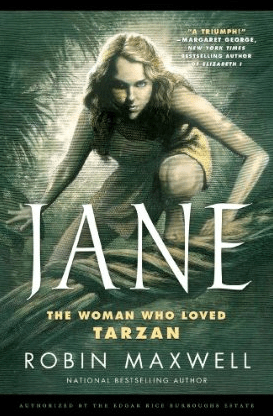
To better understand Robin Maxwell we need to go back to an interview with her that I mentioned in this blog back in February 2009. See Author Interview with Robin Maxwell of Signora da Vinci
. . . Like most people, I knew Leonardo was an amazing artist, anatomist and inventor (I’d been to one of the exhibits that display the inventions — flying machines and hydraulic systems to name a few) — that he’d created and that modern engineers executed. But I’d had no idea that he was a brilliant philosopher, an atheist who first and foremost worshipped nature; a vegetarian (at a time when such a thing was considered heretical); at different times in his life bisexual, homosexual and asexual; that he was publicly and excruciatingly tried for the crime of "sodomy"; and that he was probably a prime mover behind the Shroud of Turin hoax.
And now, Tarzan.