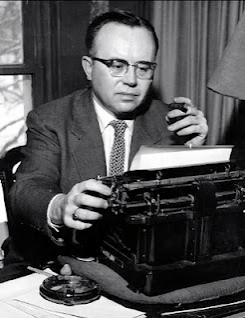
 Today, with permission, The Imaginative Conservative blog republished a 1982 essay by Russell Kirk entitled Virtue: Can It Be Taught?
The concept of virtue, like most other concepts that have endured and remain worthy of praise, has come down to us from the Greeks and the Hebrews. In its classical signification, “virtue” means the power of anything to accomplish its specific function; a property capable of producing certain effects; strength, force, potency. Thus one refers to the “deadly virtue” of the hemlock. Thus also the word “virtue” implies a mysterious energetic power, as in the Gospel According to Saint Mark: “Jesus, immediately knowing that virtue had gone out of him, turned him about in the press, and said, Who touched my clothes?” Was it, we may ask, that virtue of Jesus which scorched the Shroud of Turin?
and there was this tidbit of a definition of virtue:
For virtue, we should remember, is energy of soul employed for the general good.
and this:
[I]t is altogether possible that a general widespread renewal of faith in the supernatural and transcendent character of Christian belief may come to pass within the next few years a phenomenon more tremendous than the Great Awakening ushered in by Wesley and others two centuries ago. But to pursue that possibility here would lead me to the mysteries of the Shroud of Turin . . . .
I think that Kirk, who converted from Atheism to Christianity (Roman Catholicism specifically), believed this at a level that was less mysterious and more scientific. He understood the philosophy of science better than most and he seemed to find accommodation for miracles within it and not beyond its limits.